Project Brief
To understand the motivating factors for individuals in a community to collaboratively participate in putting their efforts towards bringing a social change in their society.
Problem Statement
Community-level participation in social work is not encouraged in many cities in India. Even though there are people who wants to contribute some of their time and effort into bringing a change. Some of the factors which hinder those actions from being executed are:
- Lack of awareness about the social activities that are happening around the community.
- People who believe in similar causes are not connected, which leads to lack of motivation.
-Not knowing how & where to start an initiative of their own.
- Cities have a floating population, because of which there is no sense of belonging or personal gratification in a community.
Secondary Data

Primary Data
I came to find out that, mostly everyone has participated voluntarily in some way or the other, through various kinds of gestures.
The only difference was the frequency at which everyone volunteers. The frequency really is an important factor in deciding an individuals experience for the events in which he or she has participated.
Why do people volunteer frequently, occasionally or maybe have not volunteered at all? What are the factors behind it?
Different categories of volunteers
For availing the user data I created a questionnaire to gather more quantitative data. From the survey results, I picked certain users for conducting interviews in order to get more qualitative data. I have included all the age groups initially to collect data, this helped me in determining the age demographics of the people who are volunteering the most. I categorised all the survey participants based on their frequency of volunteering. The interview participants were selected from these categories.

Frequent Volunteers
They started volunteering due to some experiences they faced or got inspired by people who volunteer.
They have awareness about such activities due to the contacts they made during their participation.
They have realised the impact of their efforts.
Occasional Volunteers
They are non-frequent volunteers or have stopped volunteering after some point in time due to bad experiences.
They have awareness about such events from their organisation, friends or club.
They have not realised the impact of their efforts.
Not Volunteered yet
They have not volunteered due to lack of awareness or lack of interest or priority to such events.
They don’t have any proper touchpoint or trust regarding an event.
They don’t know where to start from.
Use Case Scenarios
After the interviews were done, I got some user stories and their experiences regarding their volunteering journey. From these stories, I categorized these experiences based on the negatives and positives. I tried to take more of the negative use cases into consideration because one negative experience can lead a user to not volunteer again. These use cases will, later on, help me in the ideation stage as it will help me consider all the extreme scenarios that might come across.


Insights
Through the interviews and surveys I managed to collect some data. The insights from the collected data were then written down in small post-its and was put next to each other to gain some valuable ideas for the conceptualisation stage.
After forming the insights, I started to cluster all the insights into different categories based on their relationship to make sense of the data.
Key Findings
From all the data collected through multiple sources such as surveys and user interviews, all the insights revolved around an organised event. Not everyone has the skills to organize volunteering events, and also in a city like Bangalore, most of the population are working professionals, who have time constraints. This is one of the reasons why people look forward to joining events that are well organised so that their time and efforts are not wasted.

Through the research, I came to a conclusion that, if proper awareness and engagement happen between the volunteers and the organisers, there would be a chance of more participation from individuals in a community. This relationship will also help foster trust between the organisers and the community members, which is lacking currently.
For all of these to work out in an effective manner, there needs to be a common platform where awareness, engagement and participation can be triggered.

What should my Platform have?
To bring in awareness and a sense of engagement there needs to be a common platform that connects people to the volunteering activities happening around them. The most important aspect of such a platform should be to connect like-minded people who would volunteer for a similar cause. It also needs to connect NGO’s, organizations or individuals for collecting the monetary aspects of a volunteering event, if a single individual or a group in a community wants to conduct an event of their own.

Solution Eco-System

Stakeholders role in the solution
NGO Admin
They are in charge of registering the NGO to the platform.
They are in charge of adding social workers to the NGO list.
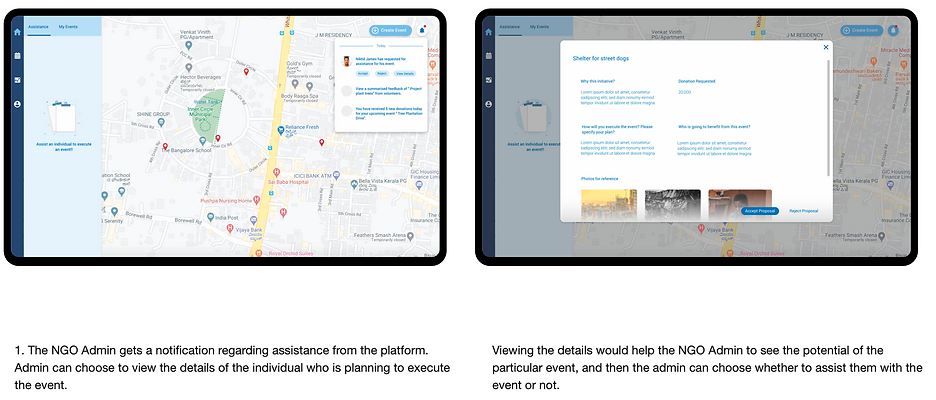
They can also monitor events where users have asked for assistance.
They can create NGO volunteering events.
They can assign their social workers to assist an event.
NGO Social Worker
They are the ones who are assigned to organise an event from the NGO side.
They can also volunteer for other events.
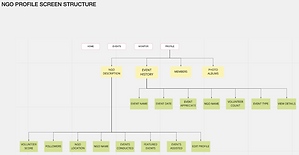
Their profile acts as a portfolio of the work they have done.
Community Members
They can create/participate in an event.
They can ask for assistance from the NGO through the platform.
They participate in an event
They can donate for an event, as well as can ask for donations while conducting an event.
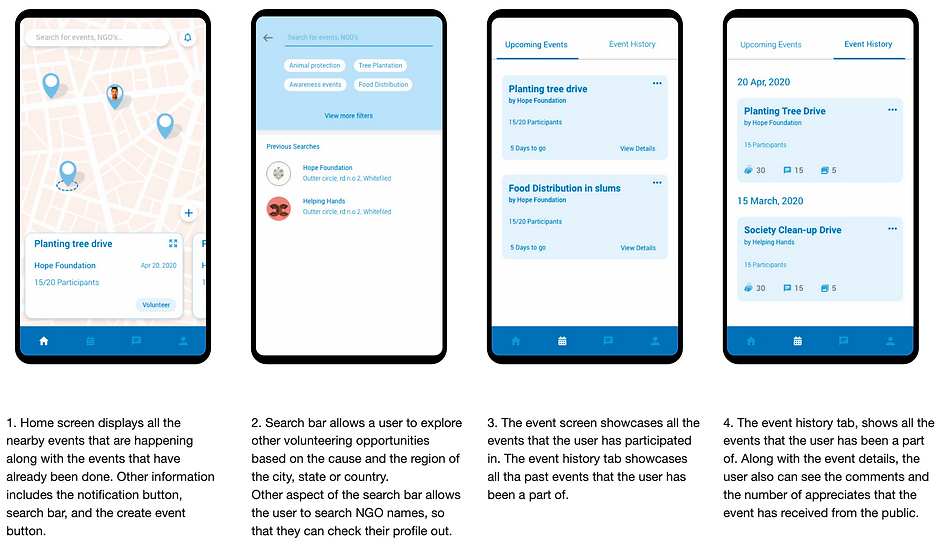
They can appreciate events that have already been conducted.
User Flows
Once all the Eco-system and stakeholders were defined, I started creating user flows for the solution. I understood the purpose of each user or stakeholder in the solution and started defining what their tasks would look like in the process.


Information Architecture


High Fidelity Screens
On Boarding
for users


On Boarding
for NGO Admin / member


Navigation Structure

Event Creation
for Users


Getting Approval
for Users


Donation Workflow
for Users


Event Alert
for Users

Navigation Structure
for NGO Admin (Desktop)