
Project Brief
- To reduce/replace the plastic food packaging provided by the restaurants via the food delivery app.
- Study the Service & Experience and try to improvise it in terms of the packaging as well as keeping the business in mind.
Problem Statement
Chosen Delivery Partner
We chose to work on Zomato as it was just a restaurant finder and then started the food delivery as it’s main POS. We wanted to study the shift of the same, the wastage it is creating and introduce a better system.
The Challenge
Food Delivery startups have resulted in the contribution of a major amount of plastic waste in the past few years. While a lot of eateries are increasing using biodegradable packaging, a fair amount is still into heavy usage of plastic packaging.
To design a sustainable system which would not only promote the use of eco-friendly packaging, but also help bring profits to the business eco-system.
Eco-System Mapping
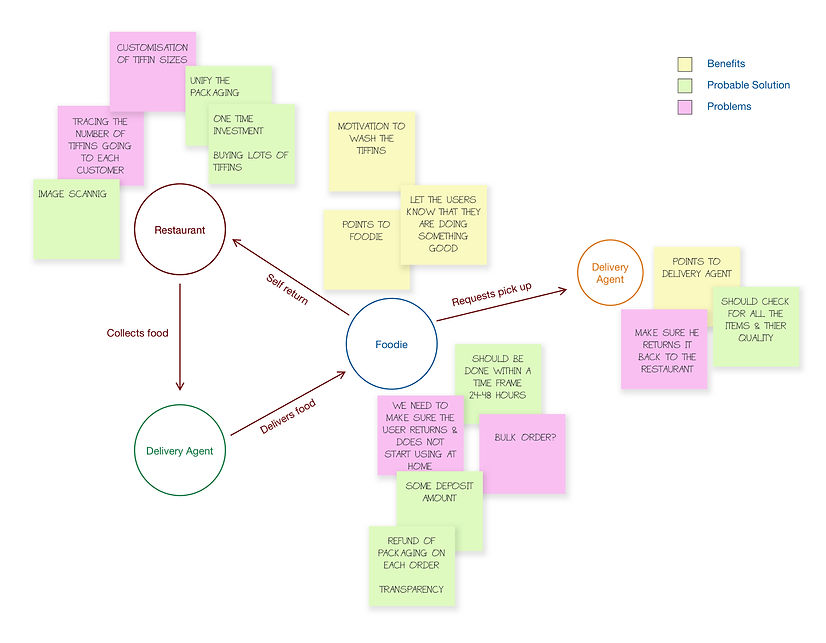
The initial step that we took was to study the whole business eco-system. This was a crucial part in defining the dependencies of the Zomato platform. This type of a systematic mapping approach helped us to visualise the intervention points for the solution.


The Major Stakeholders
It was pretty clear that Zomato’s food delivery eco-system depends on the 3 primary stakeholders which are the Restaurants, Delivery agents and the Foodies or customers. The secondary level includes all those services which helps make sure that these stakeholders perform their required tasks.
Understanding the App journey
We created a journey map of the major stakeholders in the business. This was done to point out all the touch points throughout the stakeholder’s journey.

Food Delivery Agent

Restaurants

Foodies / Customers
Since the solution was targeted for the Indian audience, It was important for us to look into the type of cuisines ordered with its respective packaging.
As part of the research we went to different restaurants in various parts of Bangalore based on the popularity / most number of orders in Zomato, to find out the type of cuisines and the packaging they are using to serve the customers. From the research we found out that plastic has been used widely by these restaurants in order for packing curry or thali based cuisines.

Brown Paper Bag
The Thali is packed in a brown paper preferably to avoid any leakage spoils. These brown paper packaging won’t be good for recycling if there any oil spillage.
The food is delivered with the bill.
Materials used :
Brown paper
Tape - BOPP
Paper for bill

Thali Packaging
Roti in the thali is wrapped in aluminium foil. Pickle is packed in the smallest of sachet.
Materials used :
Aluminium foil
Plastic for the sachet
Thali Base - Polypropylene
Thali cover - Polypropylene
The Thalis are also not reusable for household storing.

Curry or soup containers
Rest of the items like the gravy is received in a container.
Materials used :
Polypropylene
Lot of people do re use it at home but ultimately it piles up at home too and then in the landfills.
Apart from the famous International food joints, most of the other restaurants in Zomato still uses plastic containers to deliver food.
International food chains such as MC Donalds, KFC, Taco bells etc, have started using paper packaging as part of their global corporate sustainable initiative. Since they are an international brand with food stores across the world, they also have the financial resources to invest in sustainable packaging.
This further led our research into questioning why many restaurants in India refrain from using sustainable packaging?
Some of the insights we got from the restaurants were that:
1. Reiterating that there is no other alternative to deliver daal, sambhar, rasam, missal, juices and soups etc.
2. The government has not provided any strict rules or regulations pertaining to the ban of plastic containers used by restaurants.
3. Even after swiggy or Zomato partnering with eco-friendly solutions, restaurants do not prefer it due to the high cost.
4. The counter-argument is that usage of eco-friendly products like cardboard would lead to deforestation, which is more harmful than the use of plastic.
5. There are different types of restaurants that cater to a different audience. The restaurants which have cheaper rates feel that if they introduce eco-friendly packaging they would have to add separate packaging charges along with the food, which might stop the customers from ordering in that particular restaurant.
6. High-end restaurants require their own branding on the packaging which they provide, this is an interference for Zomato to sell their eco-friendly packaging.
7. There are different types of containers that the restaurants need, in terms of size, shape and what they serve.
How can we probe Restaurants to use eco-friendly packaging?
- STRICT POLICY
- INCENTIVES TO THE RESTAURANTS
- PROMOTION OF RESTAURANTS BRAND
- COSTING OF THE PACKAGING
- POLICY THAT BENEFITS THE RESTAURANTS
- WIDE AVAILABILITY OF ECO-FRIENDLY PACKAGING
- AWARENESS TO RESTAURANTS ABOUT DIFFERENT
ECO-FRIENDLY PACKAGING
- ADDING PACKAGING CHARGE DIRECTLY TO THE
FOOD ITEM. THIS WILL NOT MAKE THE USER
CONSCIOUS ABOUT THE PACKAGING CHARGE THAT IS
ADDED EXTRA ON THE BILL.
- CUSTOMIZED PACKAGING FOR EACH RESTAURANTS.
IDEATION
ACTIVITY MAPPING
Activity mapping was done to brainstorm on each strategical goals, and to get more insights on that particular strategy. While doing this we figured out that awareness on such issues are out there but there is no proper solution which was executed. One other thought which we had was to tie up with a packaging service which would provide eco-friendly packaging to the restaurants. But this was already something which Zomato was doing, and it wasn’t making much business as many restaurants didn’t opt for eco-friendly packaging due to its high price.

FUTURE WHEEL MAPPING
The other important element after narrowing down the topics was to understand its short and long term implications. Future wheel mapping helped us how the idea chosen is going to create a first order of impact (short term) and how the first impact would lead to the second order of impact (long term).
The chosen idea was, reducing plastic via a business model. The reason behind choosing this topic was due to the monetary mindset of the restaurant owners. The current market runs based on incentives, and the only way to motivate the restaurants to take up eco-friendly methods is through monetary and long term implications, and this is what we are trying to create through a business model.

BRAINSTORMING
The solution we came up with was a dabba service inspired by the Dabbawalas of Mumbai. Tiffin services according to me is one of these eco-friendly means because there is no wastage in the process. Steel tiffins can be reused because of their quality, strength, easy maintenance and odour free aspects.
As a concept, we have introduced this tiffin service as a part of a business venture for Zomato. To save some cost we have tried to incorporate the existing resources of the company such as the delivery agent.
- Restaurants who are part of the business venture - Zomato provides these restaurants with the tiffins.
- Delivery agents collect these tiffins and delivers it to the foodie.
- Foodie has to pay a deposit amount along with the food that he has ordered which is refundable.
- Foodie gets some amount of time to return these tiffins.
- Either the Delivery agent comes and picks up the tiffins back to the restaurant or the foodie could choose
to return the tiffins on their own.
SERVICE BLUEPRINT
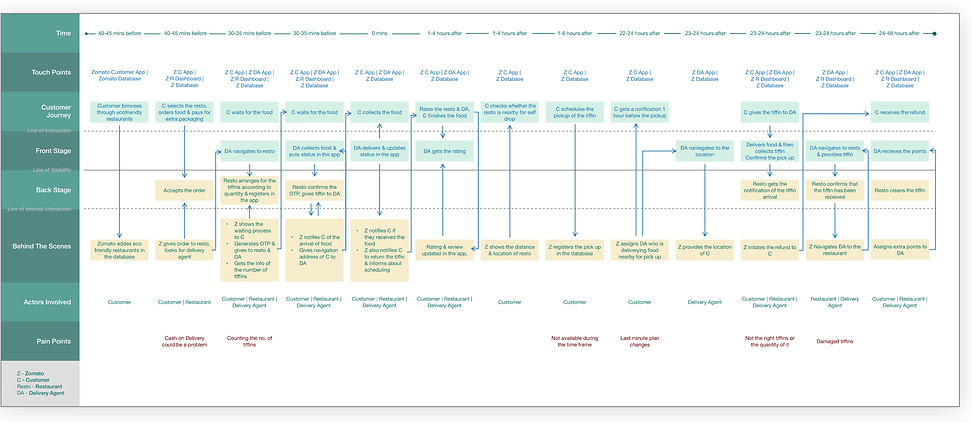
The execution phase of the plan was showcased through a service blueprint. The blueprint helps to create a detailed execution of how the service works, displaying the interaction at every stage of the service.
UI SCREENS

Before ordering the food.
The customer/foodie chooses the restaurant as well as the meal and proceeds with the payment. The tiffin deposit amount gets reflected in the bill along with an information icon. By clicking the icon the foodie gets additional information about the deposit money which can be refunded by providing the tiffin back.


After the food has been delivered.
Once the food has been delivered the foodie gets a notification in the app reminding him/her to return the tiffins. The app provides two options for the return process:
1. Self Drop - Allows the user to drop the tiffins by themselves.
2. Schedule Pick-up - Allows the foodie to schedule a date and time for the delivery agents to pick-up the tiffins.


Returning the tiffins.
By opting the self drop feature the app shows the location of the restaurant where the tiffin needs to be dropped, and also notifies the restaurant about the tiffin return so that they can confirm whether the tiffin has been returned or not. We also thought of adding some monetary points for the users who choose the self drop feature, so that the load can be reduced from the Delivery agents side.
The foodie can also choose to schedule a date and time, so that the app appoints a delivery agent in that area to collect the tiffin and drop it to its respective restaurant.


After Returning the tiffins.
By choosing any of the above returning options, the app notifies the foodie to confirm the return. After which the users gets green points added to his profile. The accumulated green points allows the foodie to avail additional discounts on the next purchases.


